One of the most popular Greek songs, and one that almost every Greek can sing along to, is “Varka sto Gialo” (Boat on the Shore).

At Omilo, language learning is always connected with culture. That’s why we regularly introduce our students to Greek singers, composers, and songs.
And of course, we even dance to some of them! 🙂

This beloved piece was composed by Mikis Theodorakis, one of Greece’s most iconic composers.
“Varka sto Gialo” is a timeless masterpiece that holds a special place in the hearts of Greeks and music lovers around the world.

The song beautifully blends feelings of longing, strength, and hope. It tells the story of a sailor facing rough seas while yearning for home.
With Theodorakis’  composition and the powerful interpretation of the singer, the song creates deep emotion, while its unforgettable melody has made it a true classic of Greek music.

click here to listen to the song


Βάρκα στο γιαλό – Lyrics in Greek

Πέντε πέντε δέκα
δέκα δέκα ανεβαίνω τα σκαλιά
για τα δυό σου μάτια για τις δυό φωτιές
που όταν με κοιτάζουν νοιώθω μαχαιριές.
Βάρκα στο γιαλό, βάρκα στο γιαλό
γλάστρα με ζουμπούλι και βασιλικό.
Πέντε πέντε δέκα
δέκα δέκα θα σου δίνω τα φιλιά
κι όταν σε μεθύσω κι όταν θα σε πιώ
θα σε νανουρίσω με γλυκό σκοπό.
Βάρκα στο γιαλό, βάρκα στο γιαλό
γλάστρα με ζουμπούλι και βασιλικό.
Πέντε πέντε δέκα
δέκα δέκα κατεβαίνω τα σκαλιά
φεύγω για τα ξένα για τη ξενητιά
και μην κλαίς για μένα αγάπη μου γλυκειά.
Βάρκα στο γιαλό, βάρκα στο γιαλό
γλάστρα με ζουμπούλι και βασιλικό.


Translation in English

Boat by the shore

Five and five makes ten.
Ten by ten I climb up the stairs
for the two eyes of yours, for the two fires
that whenever they see me, I feel knife stabs.
Boat by the shore, boat by the shore,
pot with bluebell and basil.
Five and five makes ten.
Ten by ten I will be giving to you the kisses.
And once I make you drunk and drink you,
I’ll sing you a lullaby for a sweet cause.
Boat by the shore, boat by the shore,
pot with bluebell and basil.
Five and five makes ten.
Ten by ten I climb down the stairs.
I’m leaving overseas, for new worlds
and don’t you cry about me, my sweet darling.
Boat by the shore, boat by the shore,
pot with bluebell and basil.


How can we dance on this song? Greek  Xasaposerviko dance

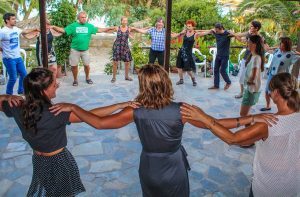
The Xasaposerviko is a lively  traditional Greek dance, which is very easy to learn.
Many Omilo students have the opportunity to learn its steps during the Greek dance lessons that follow the morning language sessions. In this dance, participants form a circle, intertwining their arms and gracefully executing energetic and rhythmic footwork. The Xasaposerviko is celebrated for its lively ambiance, accompanied by joyful music, fostering a strong sense of unity and joy within the participants.

You can also follow the same steps demonstrated in the accompanying video,

Greek dance lesson

Greek dance lesson

Click here to watch another video with the same dance,
performed by Omilo-students in different course locations (Nafplion, Syros, Lefkada), and on different songs.

Greek lesson; different words for “boat”

Why in this song the word “varka” is used, and  not “ploio” or “skafos” or “karavi”…

In Greek there are many words to describe “boat”, but they are all different boats
Want to learn more? Then take a look at podcast story 24…
https://omilo.com/easy-greek-stories-podcast-24/

greek audio story 24

Who is Mikis Theodorakis?

Mikis Theodorakis is a highly esteemed Greek composer, musician, and political figure.
Born in 1925, Greece, he is known for his immense contributions to Greek music and culture. Theodorakis’s work covers a wide range of musical genres, from symphonies and ballets to popular songs. His compositions often reflect his deep-rooted passion for social justice and political activism. Notably, Theodorakis played a significant role in the resistance against the military dictatorship in Greece during the 1960s and 1970s, which led to his imprisonment and therefore also the international recognition. His music continues to inspire audiences worldwide, making Mikis Theodorakis a revered figure in Greek and global music history.

In Greece, Theodorakis is particularly known for his popular songs that have become an integral part of the country’s musical heritage. Some of his most popular Greek songs include “Zorba the Greek” (“Sirtaki”), which became an iconic symbol of Greek culture worldwide, and many more.

Theodorakis’ ability to blend traditional Greek elements with modern sounds, along with his emotive melodies and heartfelt lyrics, has made his popular Greek songs cherished and beloved by generations, fostering a strong sense of national pride and cultural identity.

Mikis Theodorakis passed away in 2021. Click here to read more about his life.

It’s not always sunny… even in Greece, we have our rainy days!

And of course, no Greek moment is complete without music to match the mood.

For a day like this, listen to the beautiful rebetiko song «Πέφτουν της βροχής οι στάλες»
(“Raindrops are falling”),
composed by Vassilis Tsitsanis and sung by Sotiria Bellou.
Read more

Valentine day became the international day for romance, but in fact,
any time of the year, is a good time, to listen to Greek Love Songs or  Love stories!
Do you agree?
In general, Greeks are romantic! And this reflects in many love songs or real love stories…
Let’s take a look…

Read more

Greek songs and Greek music are often the reason many Greek language learners decide to start learning Greek in the first place.
Music creates an immediate emotional connection and makes the language feel alive, meaningful, and personal.

Listening to Greek songs is a fun  way to learn and build your vocabulary.
You do not only learn more about the language, but also to its culture, emotions, and everyday life. Read more

A Greek song by famous Greek singer Machairitsas is also ideal to learn Greek vocabulary.
Let’s enjoy beautiful Greek music,  while improving your Greek.

But just in case you do not know him…

Who is Machairitsas?

Read more

 Who is Dionysis Savvopoulos?

Dionysis Savvopoulos is one of Greece’s most influential musicians, since he sings, writes lyrics and composes his own songs.
Born in Thessaloniki in 1944, he became known for blending Greek folk music with rock and poetic lyrics, creating a unique sound that marked the cultural awakening of the 1960s and 1970s.  For many Greeks, Savvopoulos is not just a musician but a storyteller who captures the spirit of modern Greece through his words and melodies.

He began his career in 1964, appearing in nightclubs together with Maria Farantouri and Manos Loizos.
Savvopoulos was imprisoned twice during the Greek dictatorship. People fell in love with him straight away, making him and his music very popular in Greece and abroad.
In some of his songs, he combined the music of American musicians such as Bob Dylan with folk music from Macedonia, northern Greece, and lyrics about current political affairs. He has been awarded an honorary doctorate by the Department of Philology of the Aristotle University of Thessaloniki.

Ο Διονύσης Σαββόπουλος θεωρείται ο πρωτεργάτης της σχολής των Ελλήνων τραγουδοποιών. Τραγουδοποιοί ονομάζονται όσοι γράφουν μουσική, στίχους και τραγουδούν οι ίδιοι τα τραγούδια
τους. Άρχισε τη σταδιοδρομία του το 1964, και έκανε εμφανίσεις σε νυχτερινά κέντρα με τη Μαρία Φαραντούρη και τον Μάνο Λοΐζο.

Κατά τη διάρκεια της δικτατορίας φυλακίστηκε δύο φορές. Γνώρισε πολύ γρήγορα τεράστια επιτυχία και σύντομα έγινε πολύ δημοφιλής στην Ελλάδα και το εξωτερικό. Είχε συνδυάσει τη μουσική Αμερικανών μουσικών όπως του Μπομπ Ντίλαν με μακεδονική λαϊκή μουσική και στίχους πολιτικού περιεχομένου. Έχει ανακηρυχτεί επίτιμος διδάκτορας στο τμήμα
Φιλολογίας του Αριστοτελείου Πανεπιστημίου Θεσσαλονίκης.

Read more

Let’s learn A Greek Song for a New Haircut!

Ένα ελληνικό τραγούδι για ένα νέο κούρεμα

Did you know that Greeks love using wishes in everyday life?
They will offer good wishes at almost any opportunity;
at the start of a new month, a new week, or even when someone gets a new haircut!

Curious to learn more about everyday Greek wishes?
Download the FREE Omilo eBook + Audio on Greek Wishes

Read more

It is summer, and a perfect time to sing songs, in Greek of course 🙂

It became a tradition for some years at Omilo; singing Greek songs together with teacher Eva.
This summer one of the selected songs is

  • Τόσα Καλοκαίρια (“So Many Summers”)

  • Performer: Δάκης 

  • Composer: Μίμης Πλέσσας

  • Lyricist: Λευτέρης Παπαδόπουλος

    The song was created around 1967 and featured in the Greek musical‑film «Γοργόνες και Μάγκες» (Mermaids and Lads), directed by Γιάννης Δαλιανίδης.
    Though Δάκης’s voice is heard, he did not appear onscreen. A dancer and actress duo portrayed the scene, making it Greece’s first unofficial music video clip!

    A video clip created without all the technology existing now 🙂

    The song speaks from the perspective of someone who has finally found love, after many years of waiting, loneliness, and missed chances.
    The narrator remembers all the summers spent without love, waiting for someone special.
    Now that the beloved has arrived, everything changes; the heart is open again, and happiness returns.

    Scroll down to read the Greek lyrics as well as English translation

    Here is the link for the videoclip on YouTube
    https://youtu.be/HRsflfZLdYI?si=LScuTKasJL4GHl-Y


Read more

The Zonaradikos is a traditional Greek dance from the region of Thrace in northeastern Greece,  and it’s always a favorite among our Omilo students!

During our intensive summer courses on the Greek islands, the Greek dance lesson is a highlight of the afternoon activities. Whether you’re eager to join in and learn the steps yourself, or prefer to relax with a glass of wine while watching your fellow students dance to lively Greek music, it’s always an enjoyable and memorable experience.

It’s no secret that Greeks love to dance, and every region of Greece has its own unique style of traditional dances.

Island dances are typically joyful and rhythmic, often reflecting the gentle flow of the sea.
In contrast, Cretan dances are known for their speed and complexity,
while dances from the mountainous mainland tend to be slower and more grounded, with a heavier feel.

One particularly distinctive category comes from Thrace, in northeastern Greece.
A great example is the Zonaradikos ; a lively and much-loved dance that continues to bring people together, both in villages and on the dance floor during our Omilo programs.

The origin of the Zonaradikos

Read more

If you’re learning Greek and love Greek music, the film Eftihia is a must-see! This moving biopic offers a unique opportunity to discover the life and legacy of one of Greece’s most influential female lyricists, Eftihia Papagiannopoulou. Watching this film is not only a great way to enjoy Greek cinema but also to deepen your understanding of Greek culture and enrich your vocabulary.

Who Was Eftihia Papagiannopoulou?

Eftihia Papagiannopoulou (1893–1972) was one of the most important female figures in the Greek music scene. She wrote lyrics for hundreds of laika and rebetika songs, many of which remain popular today and are still performed in tavernas, concerts, and festivals all over Greece.

She was born in Aydin, near Smyrna (modern-day Izmir) in Asia Minor, and fled to Greece after the destruction of Smyrna in 1922. Arriving in Athens with her two daughters, she would eventually become a beloved, though often underrecognized, figure in Greek music history.

Read more