Improving your Greek with publications and online materials,
any time, any place
Which Greek Publication or eBook is right for you?
At Omilo, we know that every Greek learner is unique ; some love grammar, others prefer listening, and many just want to speak and be understood while enjoying Greek culture.
That’s why we’ve created a wide range of eBooks, designed to help you improve your Greek at your own pace and level.
Whether you’re a complete beginner, an intermediate speaker, or getting close to fluency, we love to help you out.
But we also know it can be confusing to choose the right material , especially since some topics (like proverbs or songs) are enjoyable for everyone, no matter the level!
So to help you out, here’s an overview of our eBooks, organized by language level and learning focus.
Take a look below and find your next favorite Greek resource!
++++++++++++++++++
Where can you purchase those materials?
At Omilo, our main focus is organizing high-quality Greek language courses in Greece ;
fun 1- or 2-week programs, with small groups, cultural activities, and personal attention.
All Omilo publications are available through our partner, masaresi.com ,
where you can purchase and instantly download the materials.
It is an independent online shop specialized in Greek learning materials and cultural products.
On masaresi.com, you can easily:
-
Browse all the Omilo eBooks
-
Pay securely with debit or credit card
-
Download your materials instantly
Visit masaresi.com to view all Omilo eBooks »
Ready?
Then scroll down and find the Best Materials for your level!
++++++++++++++++++++++++++++++++++++++++++++++++++++++++++++++++++++++++++++++++++++++++++++++++++++++++++++
Beginner (A1–A2)
If you’re just starting to learn Greek, or you know a few basic words and phrases but still feel unsure in conversations,
then you’re likely at the Beginner level (A1–A2).
At this stage, the focus is on:
-
Building simple vocabulary, daily Greek language
-
Learning everyday expressions or wishes, which you can use every day.
-
Understanding basic grammar, and how to conjugate verbs
-
Practicing pronunciation and reading
It’s the perfect time to develop a strong foundation, and the eBooks below are designed to help you do exactly that.
***************************************
eBooks for Beginner Levels
***************************************
Learn the Greek Alphabet!
If you do not master to read Greek yet, or know how to pronounce the words,
then this the eBook for you. When you want to learn Greek, then it all starts with the Greek alphabet!
→ https://masaresi.com/product/modern-greek-alphabet-course/
The Greek Speaking Starter Kit – Basic Sentences & Grammar
→ Learn how to form sentences, ask questions, and survive basic conversations.
–> https://masaresi.com/product/special-offer-beginners-starterkit/
Greek Wishes for Social Occasions
→ Learn how to say easy wishes, used at various occasions during the year
–> you can download this eBook for free –> https://omilo.com/for-free/free-ebook-audio-everyday-greek-wishes/
Learn How To Conjugate Greek Verbs of Group A, With Grammar Intro & Videos
→ Learn how to conjugate verbs of this category, with grammar explanations and useful sentences, + exercises and answer key
–> https://masaresi.com/product/verb-ebook-category-a/
Learn How To Conjugate Greek Verbs of Group B1 and B2 , With Grammar Intro & Videos
→ Learn how to conjugate verbs of those 2 categories, with grammar explanations and useful sentences, + exercises and answer key
–> https://masaresi.com/product/learn-how-to-conjugate-greek-verbs-b-category/
Boost Your Greek – Practice Books for A1–A2 Level
–>This beginner-friendly eBooks helps you improve reading, vocabulary, grammar, and listening skills
through 20 practical exercises per eBook and engaging text.
Includes audio, video and answer key. Ideal for self-study or as extra support for your Greek course.
–>
https://masaresi.com/product-category/ebooksgreek/boost-your-greek/
The Lydia (1) Easy Reader ; “A Summer In Greece”
You can purchase the eBook or Hard Copy, as well as extra companion eBooks; verb book, workbook and vocab books
–> https://masaresi.com/product-category/lydia-easy-reader/
Intermediate (B1–B2)
At the Intermediate level, you’re no longer a beginner . μπράβο!!
You can already handle basic conversations, read short texts, and understand the general idea of spoken Greek.
Now it’s time to:
-
Expand your vocabulary
-
Use more complex grammar (like verb tenses and cases)
-
Improve your listening and speaking confidence
-
Understand and join real-life conversations
The eBooks in this section will help you break through the “intermediate plateau” and move closer to fluency.
***************************************
eBooks for Intermediate levels
***************************************
Mastering Greek Prepositions
→ When it comes to forming sentences and thoughts in the Greek language, using the correct preposition is necessary. In this e-book, we will analyze some very important prepositions, their meaning, and their syntax. At the same time you will find examples of several sentences (translations in English included), exercises, and answer key.
https://masaresi.com/product/greek-prepositions/
The Lydia (2) Easy Reader; “A new life in Greece
→ Easy reader in Greek, intended for A2 – early stages of B1 Greek learners, and accompanied by the MP3 AUDIO-Book
Hard copy; https://masaresi.com/product/lydia-2-hardcopy/
eBook; https://masaresi.com/product/lydia-2-ebook/
«Φύγαμε για ελληνικά!»
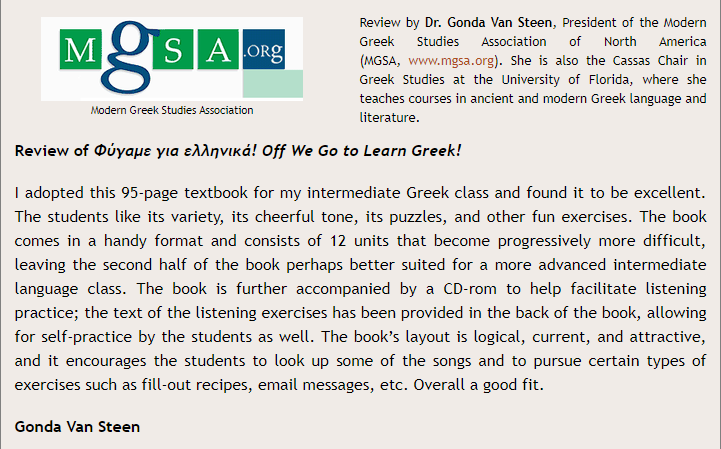
→ Improve your Greek reading/listening skills and enrich your vocabulary while learning about Greek culture and everyday life in modern Greece! The book is also accompanied by MP3 down-loadable audio files. Intended for Intermediate Greek learners (B1-B2 levels).
available in Hard Copy or eBook format
Hard copy; https://masaresi.com/product/fygame-yia-ellinka-printed/
eBook; https://masaresi.com/product/fygame-yia-ellinika/
The Easy Greek Stories ( PODCAST /YouTube & NOTEBOOKS)
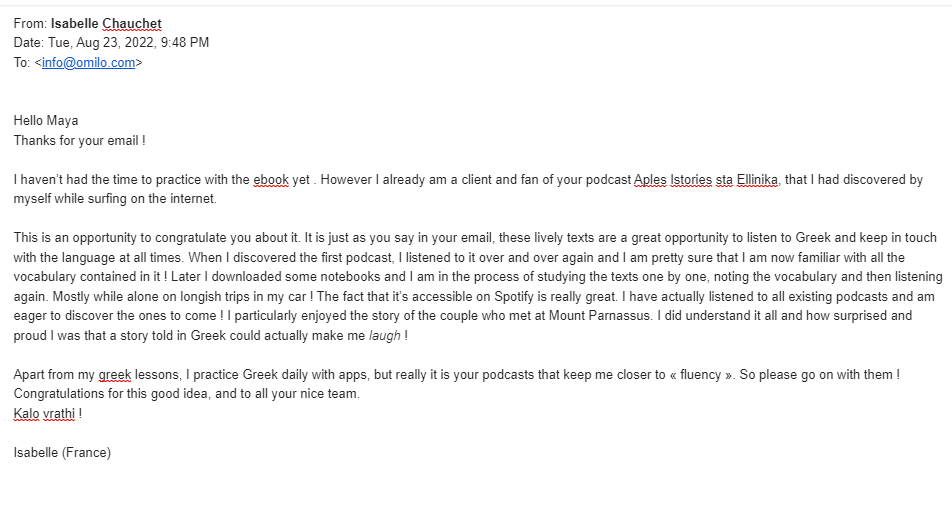
Listen to the Omilo “Easy Greek Stories Podcast” for Intermediate Learners in Greek, and improve your Greek with the accompanying digital and printable notebooks, including Greek transcript, English translation, vocab list, grammar exercises, video link + Greek subtitles, and useful info about Greece related to the story.
40 stories are written, and we continue..
For all links and info, go to https://omilo.com/podcasts/greek-stories/
You can also download a free sample at : https://omilo.com/for-free/easy-greek-stories-podcast-notebook/
Learn how to conjugate Greek passive verbs of C1 and C2 groups
→ This eBook is also useful for advanced levels, but when you are at Intermediate 2 level, you will start encounter those verbs.
Learn more about the passive verbs, the syntax phenomena, with videos, exercises, answer key, etc..
https://masaresi.com/product/conjugate-greek-passive-verbs/
Greek Songs
→ It is not always easy to understand Greek songs or its lyrics, but it is a fun way to boost your motivation to learn and understand Greek
Practice listening and vocabulary through popular, Greek songs, of all different genres
Info about all songs eBooks here; https://masaresi.com/product-category/ebooks-greece-and-greek-culture/greek-art-music/
Advanced (C1–C2)