Are you interested to learn Greek?
Then here some tips how to go from the Greek alphabet to conversations; —>start Greek with the right foundations
Learning Greek is not just about grammar and vocabulary.
It’s about:
-
Speaking with locals
-
Feeling closer to the culture
-
Understanding songs
-
Reading signs without translating
-
Connecting to history, philosophy, and everyday life in Greece
But every journey needs a first step.
Greek has a reputation for being a “difficult language”…
But in reality, most students struggle not because Greek is impossible,
–> they struggle because they start without a clear plan.
After 30 years of teaching Greek at Omilo, to international students, we’ve seen one thing again and again:
When beginners follow the right order, Greek becomes logical, structured, and even fun.
This article gives you:
-
A clear guide for beginners
-
The most important things to learn first
-
Practical learning tips
-
Links to videos, exercises, and eBooks
-
Guidance for both self-learners or course participants
Whether you are learning for travel, personal interest, family roots, or long-term studies…
this guide will help you start with confidence.
Let’s build your foundation
++++++++++++++++++++++++++
Step 1: Start with the Greek Alphabet
(but don’t get stuck there)
Why the Alphabet Matters?
The Greek alphabet is consistent and phonetic.
Once you learn the sounds, you can read almost anything.
Focus on:
-
Letter recognition
-
Basic pronunciation
-
Understanding stress marks
But don’t aim for perfection.
We often see beginners spending weeks only on the alphabet. That’s not necessary.
Focus a bit on a daily basis, but move forward confidently at the same time, learning vocabulary
The good news?
It’s much easier than it looks.
You don’t need weeks.
With the right method, you can learn it in a few days.
Free Alphabet YouTube video 1 – the 24 letters (small and capital letters)
As in any language, it is not only about 24 letters, there are also some extra combinations of vowels and consonants
Free Alphabet YouTube video 2 – the vowel combinations
Free Alphabet YouTube video 3 – the consonant combinations
If you are looking for more examples and exercises with answer keys,
then check out this useful Alphabet eBook
Important Tip
Don’t aim for perfection.
Many beginners stay too long in “alphabet mode” and delay real learning.
And other beginners believe the alphabet does not matter, and they can survive with “greeklish”
Read this article, learn the difference between greeklish and Greek, and why the Greek Alphabet really matters..
Step 2: Learn Sounds Before Grammar
Greek pronunciation is very consistent.
Once you understand:
-
vowel combinations (αι, ει, οι, ου)
-
stress marks
-
basic sound rules
you can read AND pronounce almost anything.
You can listen to the pronunciation in our videos mentioned above, but..
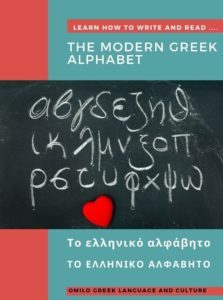
modern greek alphabet
If you would prefer to learn together with a teacher,
and practice your pronunciation
then check out the Omilo Alphabet mini-course
This builds immediate confidence.
When you can read, you feel empowered.
Step 3: Speak from Day One
This is where many learners hesitate.
They think:
“I need more grammar first.” or “I need to memorize words with an app!”
Language is not mathematics, or single words after each other, neither a written exam
It’s communication!
Yes, grammar and vocabulary are very important, but..
Start with easy sentences:
-
Greetings
-
Introducing yourself
-
Ordering coffee
-
Simple everyday phrases
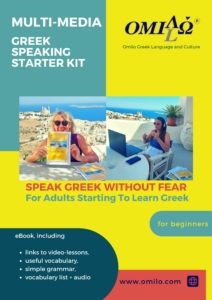 Click here to download your FREE ebook “How to Greet in Greek”
Even with limited vocabulary, you can communicate, or create connection
Confidence grows when you use the language, not when you wait for perfection.
Dare to make mistakes!
Step 4: Discover the Logic of Greek Grammar
Yes, Greek grammar has structure, a lot of it.
So it is not chaos!
Verbs follow patterns, Nouns have clear endings, Word formation shows meaning connections
For example:
γράφω — I write
γράφεις — you write
γράφει — he/she writes
You already see the pattern, in order to conjugate a verb in the present tense, you need to know the “endings”:
-ω
-εις
-ει
Now look at the noun:
γράμμα — letter
γραφή — writing
υπογραφή — signature
The root γραφ– stays the same.
When students see this, something changes.
Instead of memorizing separate words, they begin to recognize word families.
They understand that:
-
Word endings show grammar
-
Roots show meaning
-
Patterns repeat
Also for you, when you start seeing connections like this, Greek becomes fascinating.
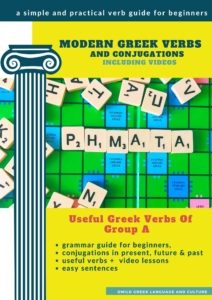 Learn more about conjugating verbs in present tense
Click here to watch the FREE Video explaining how to conjugate a verb –> To Write
The key is learning grammar in small, structured pieces, not all at once.
TIP; learning verbs is the most useful grammar for beginners.
If you can not conjugate a verb correctly, then communication will become confusing
Step 5: Build Vocabulary the Smart Way
Memorizing long word lists rarely works.
Instead:
-
Learn words in context, learn only the words you need on a daily basis in Greece
-
Learn word families
-
Learn useful phrases, not isolated words
For example, instead of only learning:
σπίτι (house)
Also learn:
-
πάω σπίτι – I am going home
-
στο σπίτι – at home
-
το σπίτι μου – at my home
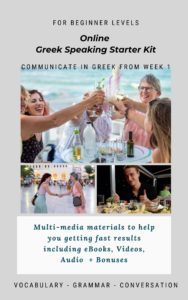
This creates active language —> language you can actually use, from the day you arrive in Greece.
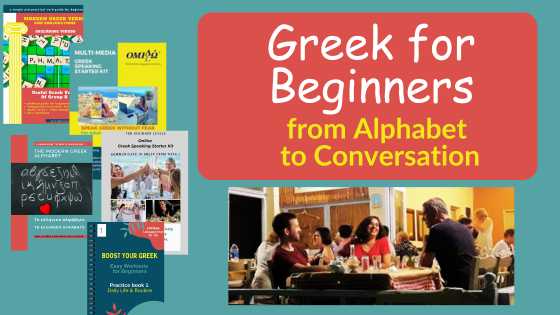
For this purpose, we have created the Greek Speaking Starter Kit, for Beginners
Click here for more info
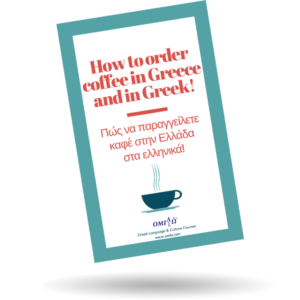 And what about preparing yourself for your next visit to Greece, and order coffee in Greek?
With this FREE eBook, you will learn ;
» How to order your preferred coffee (or another drink) in Greek,
» How to ask for extra sugar, the bill, etc,
» Helpful vocabulary, you can use everyday in Greece,
» Everyday useful sentences,
Click here for more info and download your FREE ebook
Step 6: Immerse Yourself (even at beginner level)
Enjoy the culture, the country, and stay motivated!
You don’t need to live in Greece to immerse yourself.
You can:
-
Listen to simple Greek songs, Watch slow, clear Greek videos, Read short beginner stories, Follow Greek content online
Even passive exposure builds familiarity.
Understanding 30% today becomes 50% tomorrow.
–> Articles about Greek culture
–> Articles about Greek food
–-> videos about Greek dancing on the YouTube Channel
Common Mistakes When Learning Greek
If you want to avoid frustration, avoid these:
-
Waiting too long before speaking
-
Trying to understand every grammar detail immediately
-
Comparing Greek to English constantly
-
Using too many random apps without any structure (one of the biggest mistakes students make the last 5 years…)
-
Expecting fast results without steady practice
Greek rewards patience and structure.
Dare to make mistakes…you are not the only ones 🙂
—> read here some more funny mistakes which were made by others
Should You Learn Alone or Join a Course?
Self-study works if you:
-
Follow a clear roadmap , Practice consistently, Use structured material
A group course helps if you:
-
Want correction, Prefer interaction, Need accountability, Enjoy community learning
At Omilo, we combine structured lessons with cultural experience and small groups,
online and in Greece.
 Click here for info about Online Greek lessons
Click here for our 1-and 2-week Intensive Group courses in Greece (all levels)
(Greek Language and Culture Holidays –
you can choose a course in different locations; Athens, Nafplion, Syros or Lefkada)
How to continue,
when you are already beyond Absolute Beginner Level?
Beginner A1–A2 levels
If you already:
-
Know the Greek alphabet
-
Use present tense verbs
-
Can introduce yourself and read simple texts
but still feel unsure or slow when speaking … this is completely normal.
At the advanced beginner level, you need more structured practice.
This means:
-
Strengthening verb patterns
-
Expanding everyday vocabulary
-
Building longer sentences
-
Listening to slightly more complex dialogues
-
Gently preparing for past tenses
That’s why we offer dedicated materials for this level,
including structured practice eBooks, short story collections, vocabulary modules, and guided online lessons.
***************************************
eBooks for Advanced Beginner Levels
***************************************
 Learn How To Conjugate Greek Verbs of Group B1 and B2 , With Grammar Intro & Videos
→ Learn how to conjugate verbs of those 2 categories, with grammar explanations and useful sentences, + exercises and answer key
–> https://masaresi.com/product/learn-how-to-conjugate-greek-verbs-b-category/
 Boost Your Greek – Practice Books for A1–A2 Level
–>This beginner-friendly eBooks helps you improve reading, vocabulary, grammar, and listening skills
through 20 practical exercises per eBook and engaging text.
Includes audio, video with Greek and English text (so you can read along) and answer key.
Ideal for self-study or as extra support for your Greek course.–> https://masaresi.com/product-category/ebooksgreek/boost-your-greek/
 The Lydia (1) Easy Reader ; “A Summer In Greece”
You can purchase the eBook or Hard Copy, as well as extra companion eBooks; verb book, workbook and vocab books
–> https://masaresi.com/product/lydia-easy-reader-audio/

Even better, the Complete Lydia Package
The Lydia (1) Easy Reader ; WORKBOOK AND VERB-BOOK
–>https://masaresi.com/product/special-offer-lydia-ebook-package/
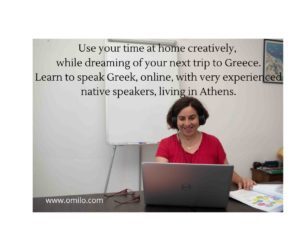
Greek online lessons with Zoom
Online lessons with an Omilo teacher
Omilo’s online Greek lessons offer structured progression, and personal guidance from experienced teachers.
They are designed to help you build real confidence , step by step, in a supportive and interactive environment.
–> https://omilo.com/course/greek-skype-lessons/