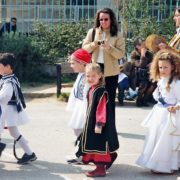

Every year on October 28, Greeks celebrate one of the country’s most important national holidays: Oxi Day (Ημέρα του Όχι).
The word όχι (ochi) means “no” in Greek, and the anniversary commemorates Greece’s rejection of an Italian ultimatum in 1940 and the country’s subsequent entry into World War II.
Greece has two major national holidays connected to important events in modern Greek history:
- March 25, commemorating the beginning of the Greek War of Independence in 1821
- October 28, commemorating Greece’s resistance to the Italian ultimatum in 1940
October 28 is a public holiday throughout Greece. Schools, public services and many businesses are closed, while towns and villages across the country mark the anniversary with parades, ceremonies and Greek flags.
But what exactly happened on October 28, 1940, and how do Greeks celebrate Oxi Day today?
What happened in Greece on October 28, 1940?
In the early hours of October 28, 1940, the Italian ambassador to Greece, Emanuele Grazzi, visited Greek Prime Minister Ioannis Metaxas at his home in Athens.
On behalf of Italian dictator Benito Mussolini, Grazzi presented Metaxas with an ultimatum demanding that Greece allow Italian forces to enter the country and occupy strategic locations.
Metaxas rejected the ultimatum.
His actual response was reportedly given in French: “Alors, c’est la guerre” – “Then it is war.”
The rejection was soon expressed by the Greek population with one simple word: Όχι! – No!
This is why October 28 became known as Oxi Day.
Within hours, Italian forces attacked Greece from Albania, which at the time was under Italian control. The Greco-Italian War had begun.
The Greek army successfully resisted the initial Italian offensive and pushed Italian forces back into Albania. Several months later, in April 1941, Nazi Germany invaded Greece.
The Axis occupation of Greece continued until 1944, bringing immense hardship to the country and its population.
Today, October 28 commemorates Greece’s resistance and the people who fought during this period.
How do Greeks celebrate Oxi Day?
If you are travelling in Greece around October 28, you will quickly notice that something special is approaching.
In the days and weeks before the anniversary, Greek flags appear on streets, public buildings, houses and balconies. Television channels show documentaries and films related to World War II, while songs associated with the period can also be heard.
Schools play an important role in the celebrations.
Pupils learn about the events of 1940 and prepare school celebrations with poems, songs, historical texts and theatrical performances.
They also practise for one of the most visible traditions of October 28: the school parade.
If you are interested to read more on how young children celebrate this day, then click here and read more
School parades throughout Greece
On October 28, schoolchildren and students take part in parades in cities, towns and villages across Greece.
They march through the main streets while families, friends and local residents gather to watch and applaud, often carrying small Greek flags.
One student traditionally has the honour of carrying the Greek flag at the front of the school group.
In Greek, this student is called the σημαιοφόρος (simeofóros) – the flag-bearer.
Before the parade, local authorities, schools and organisations usually take part in commemorative ceremonies and lay laurel wreaths at local war memorials.
In larger cities, there are also official parades and ceremonies. The best-known military parade takes place in Thessaloniki, while Athens and other cities hold student parades.
And on the Greek islands, the celebrations naturally have their own local atmosphere.
In our video, you can see schoolchildren on the island of Syros practising for their October 28 parade, some weeks before the big day
What happens after the parade?
Since October 28 is a national holiday, it is also a day when families and friends have time to be together.
After watching or participating in the parade, many people meet for coffee or enjoy a long lunch in a taverna.
Depending on where you are in Greece, you might also come across traditional music and Greek dancing as part of the local celebrations.
So, if you happen to be in Greece on October 28, expect to see plenty of blue and white flags – and perhaps a parade passing through the centre of the town or village where you are staying!
You can also take a look at another Oxi Day celebration on the island of Naxos.
A famous song connected with the war: “Children of Greece”
Music also played an important role during the war years.
One of the best-known songs associated with the period is «Παιδιά της Ελλάδος παιδιά» (Pedia tis Ellados Pedia),
which can be translated as “Children, Children of Greece.”
The song was famously performed by Sofia Vembo, one of the most celebrated Greek singers of the period.
Her wartime songs became closely associated with Greek morale and resistance.
Listening to the song is also a nice opportunity for learners of Greek to combine language, music and modern Greek history.
You can listen to the song on YouTube and follow the Greek lyrics and their translation:
https://youtu.be/BPJOCu1fNC0
An example of a heroic song of the time
Title: Children Children of Hellas
Click here to Listen to the song on YouTube, and read the lyrics as well as the translation.
Τραγούδι: «Παιδιά της Ελλάδος παιδιά»
| Στίχοι: Μίμης Τραϊφόρος | Lyrics: Mimis Traiforos |
| Μουσική: Μιχάλης Σουγιούλ | Music: Mihalis Souyioul |
| Πρώτη εκτέλεση: Σοφία Βέμπο | First version: Sofia Vebo |
| Μέσ’ στους δρόμους τριγυρνάνε | Mothers are wandering in the streets |
| οι μανάδες και κοιτάνε | Seeking |
| ν’ αντικρίσουνε, | To face |
| τα παιδιά τους π’ ορκιστήκαν | Their children who took an oath |
| στο σταθμό όταν χωριστήκαν | When they parted at the station |
| να νικήσουνε. | To win at war |
| Μα για `κείνους που `χουν φύγει | But let’s be glad |
| και η δόξα τους τυλίγει, | For those who have left us |
| ας χαιρόμαστε, | And have been wrapped in glory |
| και ποτέ καμιά ας μη κλάψει, | And may none of us ever cry |
| κάθε πόνο της ας κάψει, | May bury her sorrow |
| κι ας ευχόμαστε: | And let’s all wish: |
| Παιδιά, της Ελλάδος παιδιά, | Children, children of Hellas |
| που σκληρά πολεμάτε πάνω στα βουνά, | Who are fighting a tough war on the mountains |
| παιδιά στη γλυκιά Παναγιά | Children, towards Virgin Mary |
| προσευχόμαστε όλες να `ρθετε ξανά. | We do pray for you to come back again |
| Λέω σ’ όσες αγαπούνε | I say to those who love |
| και για κάποιον ξενυχτούνε | And stay all night awake |
| και στενάζουνε, | And sigh |
| πως η πίκρα κι η τρεμούλα | that bitterness and trembling |
| σε μια τίμια Ελληνοπούλα, | Do not fit |
| δεν ταιριάζουνε. | A proper Hellene woman. |
| Ελληνίδες του Ζαλόγγου[1] | Hellene women of Zalongo, |
| και της πόλης και του λόγγου | Of the cities and the forests |
| και Πλακιώτισσες[2], | And women of Plaka, |
| όσο κι αν πικρά πονούμε | However bitterly we suffer |
| υπερήφανα ας πούμε | Let’s cry out proudly |
| σαν Σουλιώτισσες. | Like women of Souli would do: |
| Με της νίκης τα κλαδιά, | Children, we are expecting you |
| σας προσμένουμε παιδιά | Carrying palm branches of victory. |
[1] Zalongo, a village in Epirus, is known for the Dance of Zalongo: in 1803 women from Souli and their children committed mass suicide by throwing themselves off a steep cliff in order to avoid enslavement by the Ottomans.
[2] Plaka is an old historical neighborhood of Athens, on the slopes of Acropolis.
Learn Greek through Greek culture
At Omilo, we believe that learning Greek is about much more than grammar and vocabulary.
Understanding celebrations such as October 28 – Oxi Day helps you understand Greek history, traditions and everyday life.
It also gives you something interesting to talk about with Greeks!
So, if you are in Greece on October 28:
Look out for the Greek flags
Watch a local parade
️ Practise saying Χρόνια πολλά! to the Greeks you meet
Listen to some of the songs associated with the anniversary
☕ And enjoy the holiday atmosphere like the locals do…and of course, join the circle dances!
Χρόνια πολλά, Ελλάδα!