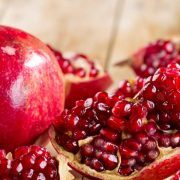
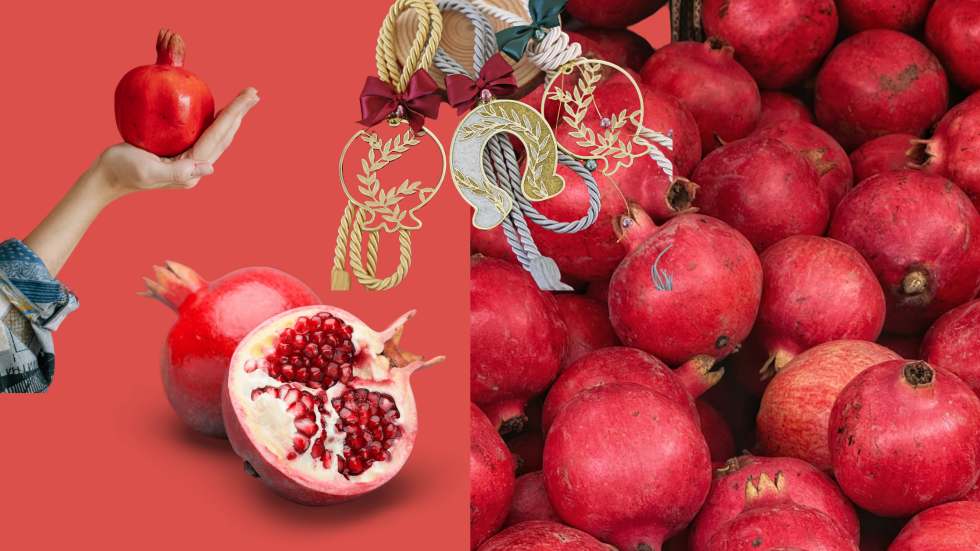
On the first day of the New Year, many Greek homes welcome the year ahead by breaking open a pomegranate for good luck. This beautiful ritual is believed to bring health, prosperity, and abundance to the household. It is also common in Greece to exchange pomegranates (ρόδι), often made of metal, glass, or ceramic, as New Year’s gifts. These symbolic objects are known as γούρια; charms meant to bring good fortune for the year to come.
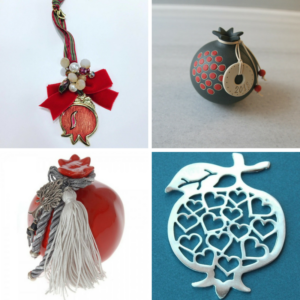
Some examples of a „γούρι“:
Greek traditions are rich in symbols of good luck, prosperity, and protection. One of the most well-known Greek good luck traditions is the breaking open of a pomegranate (ρόδι), especially at weddings, on New Year’s Day, and during important life events. This custom is strongly connected with wishes for fertility, abundance, and a prosperous future, and its origins go back to ancient Greek history and mythology.
The Pomegranate in Greek Mythology
In ancient Greece, the pomegranate was a powerful symbol of fertility, rebirth, and the eternal cycle of life. Its deep red color and many seeds made it a natural symbol of abundance. Several goddesses were associated with this sacred fruit, including Hera, the protector of marriage and family, and Persephone, the daughter of Demeter.
One of the most beautiful Greek myths connects Persephone with the pomegranate. After her abduction by Hades, she was eventually allowed to return to the world above to reunite with her mother. Her return brought spring and life back to the frozen earth. Before she left, however, Hades offered her a few pomegranate seeds. By eating them, Persephone remained forever connected to the Underworld, which explains why she must return there every year. This myth reflects the changing seasons and reinforces the pomegranate’s symbolism of life, death, and renewal.
Other Greek Luck Charms (Γούρια)
Besides the pomegranate, there are many other Greek good luck charms, known as γούρια, that are traditionally used to bring protection and positive energy. One of the most common is the onion (κρεμμύδι), which is often hung outside the home on New Year’s Day. Because it continues to grow even after being harvested, the onion symbolizes rebirth, growth, and continuity.
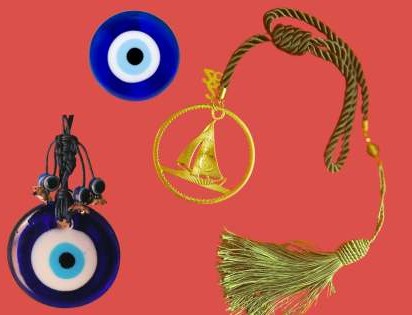
Other popular Greek γούρια include the evil eye (μάτι), used for protection against negative energy, the horseshoe for luck and stability, and the boat (καράβι), which represents safe journeys and new beginnings. This is especially important in a seafaring culture like Greece.
All these symbols are still widely used today, connecting modern Greek life with ancient beliefs and traditions.