Ready to learn one of the most useful verbs in Greek?
πάω = I go
With just this one verb, you can already say many things in everyday situations.
Greek can sometimes feel a bit challenging at the beginning…
New letters, different sounds, long words…
But here’s the good news:
You don’t need to learn everything at once.
There are simple, practical things you can start using right away.
And this is one of them.
In this article, you’ll learn how to use the verb πάω in real-life situations, with easy phrases you can start saying from today.
You’ll also find a video with audio, so you can listen, repeat, and practice your pronunciation.
Let’s go πάμε!
The Conjugation of the verb to go – πάω
Let’s first see how to use the verb πάω in the present tense.
Good news! it’s easier than you might think
In Greek, you often don’t need to say words like “I”, “you”, or “we”.
So, the verb ending already shows who is doing the action. So in many cases, just using the correct verb form is enough.
|
(εγώ) πάω |
(ego) pao | I go |
|
(εσύ) πας |
(esy) pas | You go |
|
(αυτός/αυτή) πάει |
(avtos/avti) paei |
He/she goes |
| (εμείς) πάμε | (emeis) pame |
We go |
| (εσείς) πάτε | (eseis) pate |
You go |
| (αυτοί) πάνε | (avtoi) pane |
They go |
The verb + simple daily Greek vocabulary
Click here to listen to the video , as well as the correct pronunciation

Now you know to conjugate the verb, you can easily learn some expressions by adding simple daily vocabulary.
Ι. Πάω/Πάμε για… (to “go for”)
(Listen to the correct pronunciation with the AUDIO-link below)
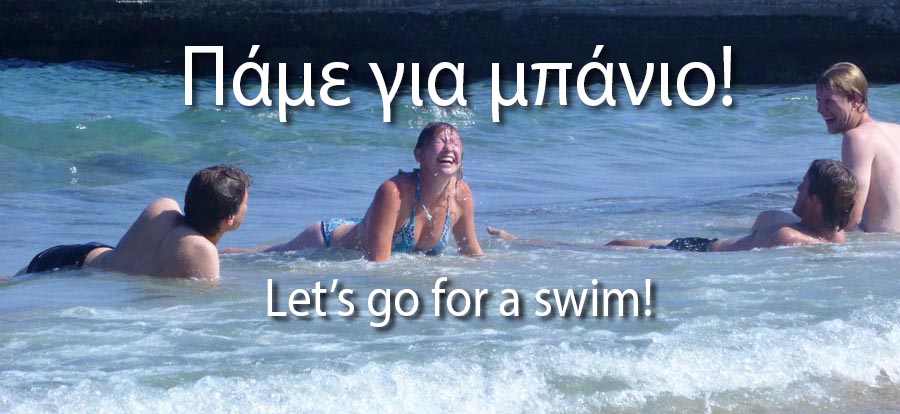
1. Πάω για μπάνιο [pao gia banio] (*) I am going for a swim
2. Πάω για ύπνο [pao gia ypno] (**) I am going to sleep
3. Πάω για ψώνια [pao gia psonia] I am going for shopping
4. Πάω για καφέ [pao gia kafe] I am going for a coffee
5. Πάω για ποτό [pao gia poto] I am going for a (alcoholic) drink
6. Πάω για φαγητό [pao gia fagito] I am going to eat (out)
7. Πάω για κούρεμα [pao gia kourema] I am going for a haircut
8. Πάω για τρέξιμο [pao gia treksimo] I am going to run/ for jogging
9. Πάω για μάθημα [pao gia mathima] I am going for/to my lesson
(*) In case you really “swim a distance” (and not just sit/play in the water/sea), then you say : [pao gia kolumbi]
(**) If you have difficulties memorizing the word “ypno” (sleep), think of “hypnotize” and you will now realize how many Greek words you use in your own language!
II. Even easier, in the following sentences you do not need any preposition:
(Listen to the correct pronunciation with the AUDIO-link below)
Πάω σπίτι. [pao spiti] I am going home.
Πάω θέατρο. [pao theatro] I am going to the theatre.
Πάω σινεμά. [pao cinema] I am going to the cinema.
Πάω διακοπές [pao diakopes] I am going on holidays
Πάω βόλτα [pao volta] I am going for a walk/stroll
III. Let’s go for a coffee! Shall we go for a coffee?
In case you would like to say: Let’s go for a coffee, Let’s go for a drink, etc…you simply use the “we form” of the verb:
Πάμε για καφέ – “Pame gia kafe”, “Pame gia poto”, etc…
You can also change your intonation and make it a question : Πάμε για μπάνιο; “Pame gia banio?” (shall we go for a swim?)
IV. When do we go on holiday? Where do we go for holidays?
If you want to ask “when” (Πότε) or “where” (Πού ) then just add the words in front of the sentence:
Που πας? (Where are you going?)
Που πάμε για διακοπές? (Where are we going on holidays?)
Πότε πας για φαγητό? (When are you going for food?)
Be careful: When you use “πότε” (when), make sure the stress is on the “O”.
In case you pronounce it with the stress on the “e” (ποτέ), you actually say “never”.
Hope you will soon be motivated to speak Greek!
Keep it simple and enjoy learning Greek, with one more video !
+++++++++++++++++++++
Now that you started learning Greek verbs in different tenses,
it is the perfect time to proceed
and start using more active Greek verbs,
of
A, B1 and B2 category.
Take a look at the verb eBooks, including videos (as here above),
which will help you to communicate in Greek.